The Best Way to Exchange Currency (and the Worst), Compared
ATM abroad, home bank, airport kiosk or card? The real cost of each way to get foreign currency, with a worked $500 example and a plan for your trip.
 Live FX Editorial Team · · 5 min read
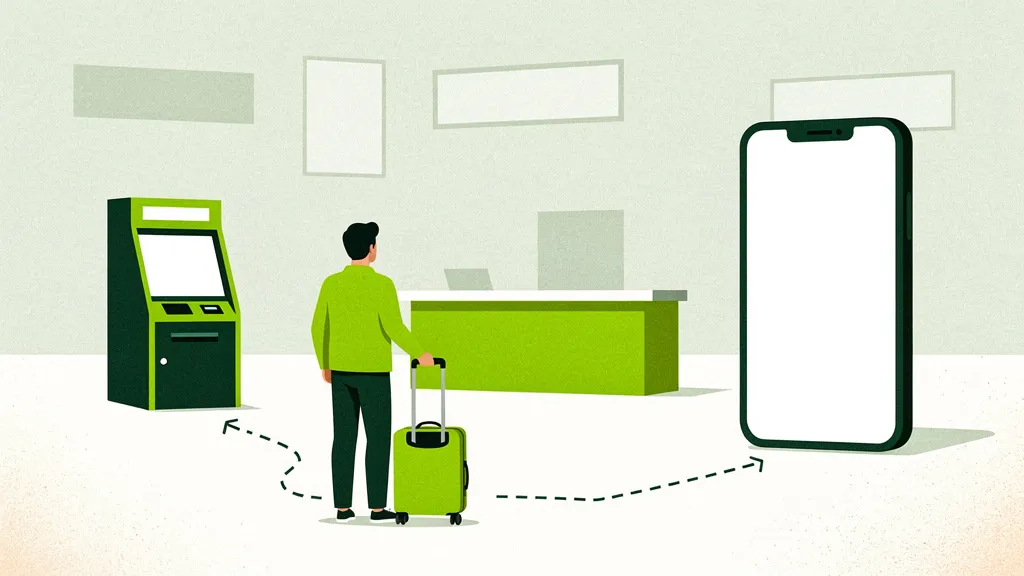
For most travelers the cheapest way to get foreign currency is to pay by card in the local currency and withdraw cash from a bank ATM at your destination, using cards with no foreign transaction fees and declining any conversion the machine offers. Ordering a small amount from your own bank before you go is a reasonable backup; airport and tourist-area exchange kiosks are usually the most expensive option.
On this page
There are half a dozen ways to turn your dollars into euros, pesos or yen, and the difference between the best and the worst can be 10% or more of what you spend. The good news: the cheapest options are also the easiest. This guide ranks them by real cost, walks through a $500 example and ends with a step-by-step plan.
Rates in this guide are mid-market rates from Live FX as of November 12, 2026 ($1 = €0.9028; €1 = $1.1077). Check today’s rate for your destination on the currency converter.
The short version
- Pay by card wherever cards are accepted, in the local currency, with a card that has no foreign transaction fee.
- Withdraw cash at a bank ATM after you arrive, with a debit card that has low or no foreign and ATM fees. Decline any conversion the ATM offers.
- Carry a small cash buffer from home only if you want one; order it from your bank a week ahead.
- Avoid airport, hotel and tourist-strip kiosks unless it’s an emergency.
Every option, ranked by cost
| Method | Typical cost vs mid-market | Convenience | Best for |
|---|---|---|---|
| Card purchase in local currency, no-fee card | ≈0% (network rate) | Excellent | Most spending |
| Bank ATM abroad, no-fee debit card, conversion declined | ≈0% + any ATM operator fee | Very good | Cash on arrival and during the trip |
| Card or ATM with a standard bank card | ~3% + per-withdrawal fees | Very good | When you have no fee-free card |
| Ordering currency from your home bank | Spread built into the rate, plus delivery fees on small orders | Good (needs planning) | A small buffer before you leave |
| Exchange office in town | Varies widely; compare the amount you’ll receive | Good | Exchanging leftover cash |
| Dynamic currency conversion (paying in USD abroad) | Measured at 2.6%–12% extra in European tests | Feels easy | Never; always decline |
| Airport and hotel kiosks | Often the worst; UK surveys found ~13%–17% below market | Convenient | Emergencies only |
The card and ATM figures assume you avoid foreign transaction fees and dynamic currency conversion; the kiosk and DCC figures come from consumer investigations listed in the sources.
Worked example: turning $500 into euros
At the mid-market rate, $500 is worth €451.39. Here’s roughly what each route leaves you with:
| Route | What you pay | Euros you get | Lost vs mid-market |
|---|---|---|---|
| ATM abroad, no-fee debit card, conversion declined | $500 | about €451 | ≈$0 (plus any ATM operator fee) |
| ATM abroad, standard debit card (3% + $5) | $520 | €451.39 | $20 |
| Airport kiosk 13% below market | $500 | about €399 | about $58 |
| ATM conversion accepted (7% markup) + $5 ATM fee | $535 + $5 | €451.39 | about $40 |
The kiosk line uses the average gap found in a UK newspaper’s survey of airport bureaux; actual rates vary by airport and day, so use the method below to check any quote.
How to judge any exchange offer in 30 seconds
Signs saying “0% commission” or “no fees” tell you nothing: the cost is hidden in the rate. Instead:
- Look up the mid-market rate on Live FX (USD to EUR, USD to GBP, USD to MXN…).
- Ask the exchange office how much foreign currency you’ll receive for your amount, after all fees.
- Markup = (mid-market amount − amount offered) ÷ mid-market amount.
Example: for $500 a kiosk offers €420. Mid-market is €451.39. (451.39 − 420) ÷ 451.39 = 7.0%.
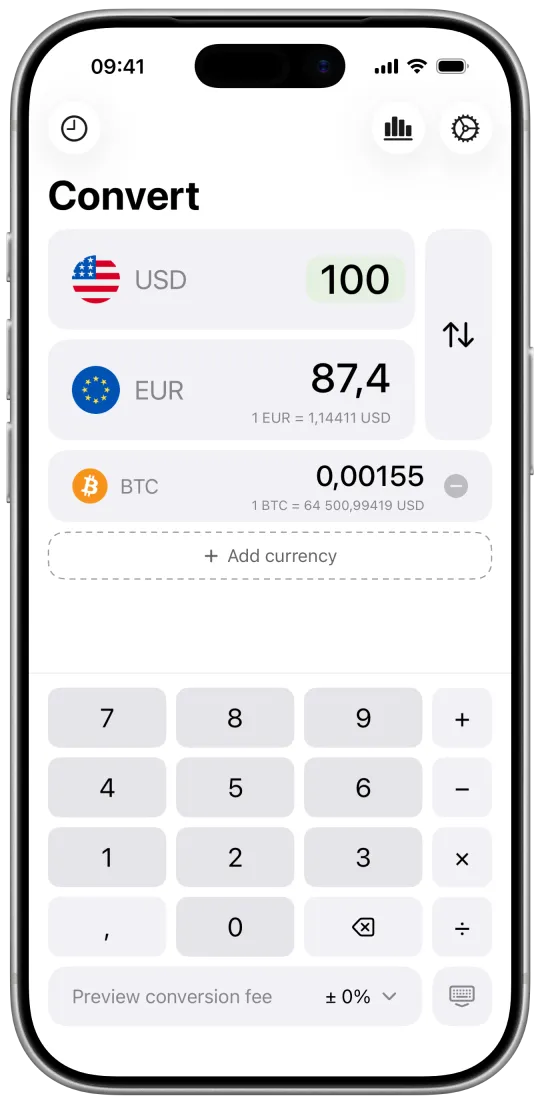
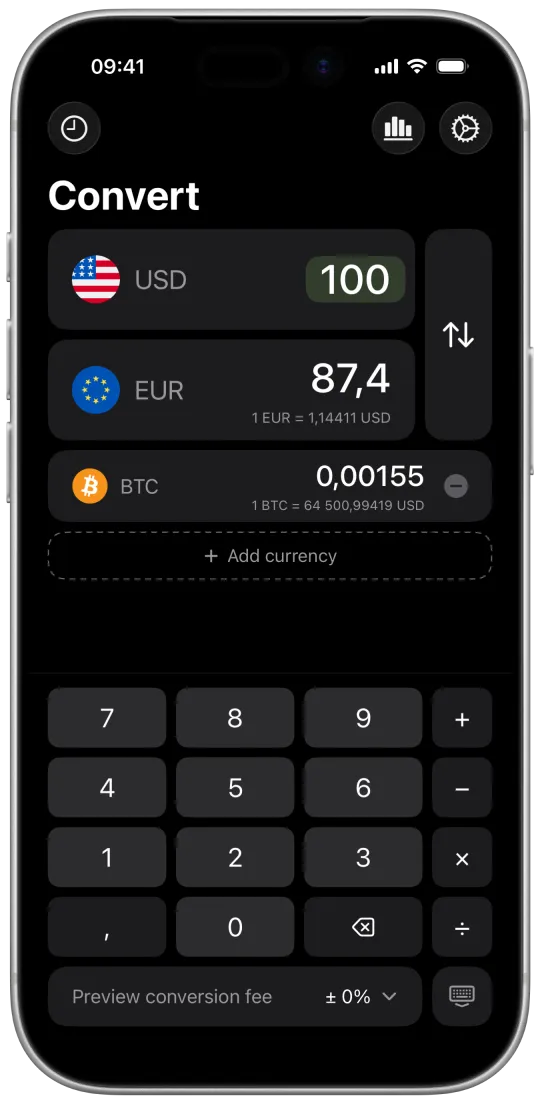
The Live FX iPhone app makes this instant even without data roaming: it keeps the last rates offline, and its fee preview applies a typical ATM, card or kiosk markup (or your own percentage), so you can see the real price on the spot. Our guide to how exchange rates work explains the math in more detail.
Ordering currency from your bank before you go
Most big US banks will sell you foreign cash:
- Chase says it doesn’t charge a fee for foreign currency exchange, but its rates include commissions and spreads. Orders are placed in a branch and are usually ready in one to two business days, so order at least three business days before you travel.
- Bank of America lets you order online for delivery or branch pickup; standard shipping is free on orders of $1,000 or more and costs $7.50 below that, with standard delivery in about one to three business days.
Because the spread is in the rate, compare the euro amount you’re quoted with the mid-market rate before you confirm. This route makes most sense for a small buffer: enough for a taxi and a first meal.
At the ATM abroad
- Use bank-owned ATMs inside or attached to a bank branch. Standalone machines in tourist areas, often run by independent operators, tend to charge higher access fees and push conversion.
- Decline conversion. If the screen offers a “guaranteed rate” in dollars, choose to continue without conversion. Visa notes that merchants and ATMs must give you the choice and must not choose on your behalf.
- Choose the account type “checking” if asked, and withdraw amounts that limit per-withdrawal fees without carrying more cash than you’re comfortable with.
- In Japan, use 7-Eleven or Japan Post Bank ATMs (see our cash in Japan guide).
Exchanging leftover cash when you get home
Exchanging money back usually costs a second spread. Options:
- Keep it for your next trip to the same currency area.
- Spend coins at the airport (coins usually can’t be exchanged back at all).
- Exchange large amounts of banknotes at your bank or a competitive exchange office, comparing the rate the same way.
Your pre-trip checklist
- Check every card for foreign transaction fees and ATM fees.
- Bring at least two cards on different networks (Visa and Mastercard).
- Tell your bank where you’re going if your bank asks for travel notices.
- Note the mid-market rate for your destination, or save it in an offline converter.
- Decide on a small cash buffer, if any, and order it a week ahead.
- Remember the two rules at every terminal and ATM: local currency and decline conversion.
- Read up on local tipping habits: Europe, Japan.
Frequently asked questions
What is the cheapest way to get foreign currency?
Usually withdrawing cash from a bank-owned ATM in the country you're visiting with a debit card that charges no foreign transaction fee and rebates or avoids ATM fees, and declining the ATM's offer to convert the amount. Paying by card in the local currency is cheaper still for anything that accepts cards.
Is it better to exchange money before traveling or after arriving?
For most destinations, after arriving, via a bank ATM. Exchanging at home costs a spread, and airport kiosks cost more. Exchanging a small amount before you go only makes sense for peace of mind, for countries where ATMs are scarce, or if your cards charge high foreign fees.
Where is the best place to exchange money?
Compare the amount of foreign currency you'll actually receive, not the advertised fee. Bank ATMs abroad, your own bank or credit union and competitive city exchange offices usually beat airport, hotel and tourist-area kiosks. Check the mid-market rate first so you can calculate each offer's markup.
Do banks exchange foreign currency for free?
Many US banks don't charge a separate fee to sell you foreign currency, but the exchange rate includes a spread. Chase, for example, says it doesn't charge a fee for foreign currency exchange but that its rates include commissions and spreads. Some banks also charge delivery fees for small orders.
Is airport currency exchange a rip-off?
It is usually the most expensive place to buy currency. UK investigations have found airport bureau rates around 13% to 17% worse than the market rate. If you need cash on arrival, an ATM in the arrivals hall is normally much cheaper.
Sources
- Which?: How to save money while you're on holiday (2022)
- The Times: Airports profit in currency rip-off (survey of 20 UK airport bureaux)
- Pound Sterling Live: FairFX finds Heathrow rates 17% below the market rate
- Chase: Foreign exchange services
- Bank of America: Foreign currency order FAQ
- Visa: Dynamic Currency Conversion
Rates quoted in this guide are mid-market reference rates from Live FX’s data (the open currency-api dataset for fiat and metals, CoinGecko for crypto) and are for information only. Fees change, so check your own bank’s current terms before you travel.
Rates in your pocket, even offline
Live FX for iPhone converts 340+ currencies, crypto and gold in one tap, with charts, home-screen widgets and custom rates. Works without a connection using the last rates.